
Nikro Air Duct Cleaning in Clearwater: A Homeowner’s Guide
Most homeowners in Clearwater ask the same thing before booking: does the equipment actually matter, or is a vacuum a vacuum? Nikro air duct cleaning is a specific answer to that question. Nikro builds portable negative-air machines and agitation tools with published CFM ratings and staged HEPA filtration, and those specs decide whether your duct system gets genuinely cleaned or just surface-skimmed. If you’d rather have a trained crew handle it than climb into the attic yourself, call (844) 238-0931.
The truck-mounted vacuum a generalist HVAC company brings is typically sized for speed, not for the sustained negative pressure that portable units maintain throughout a full residential job. That gap is the whole story. Here’s what Nikro gear does mechanically, and what to ask any contractor before you book.
What is a Nikro negative-air machine, and why do restoration crews use one?
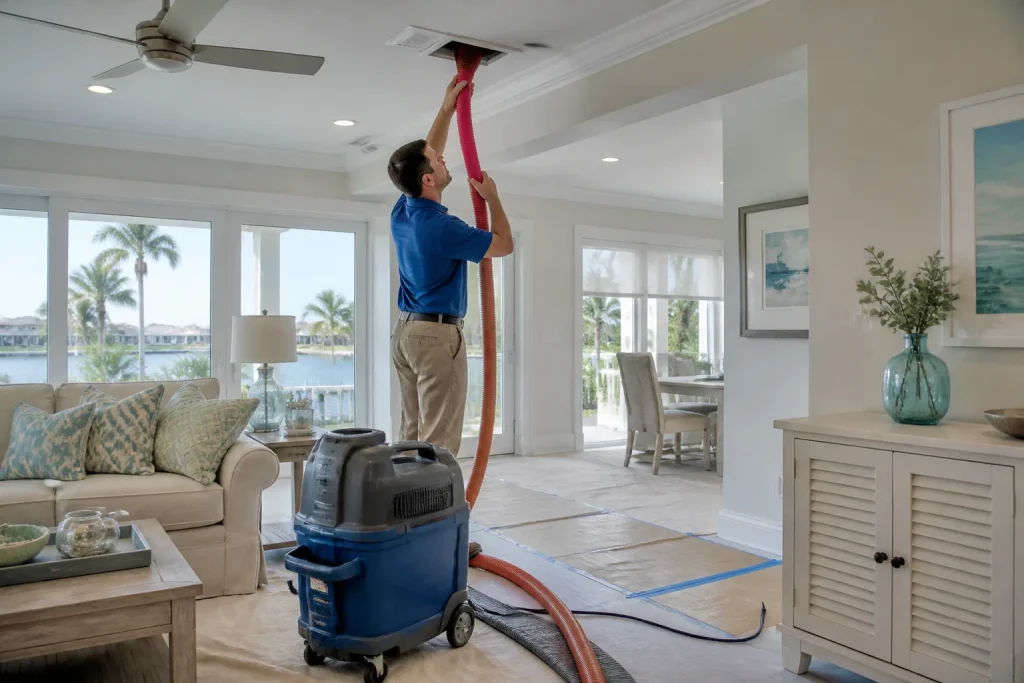
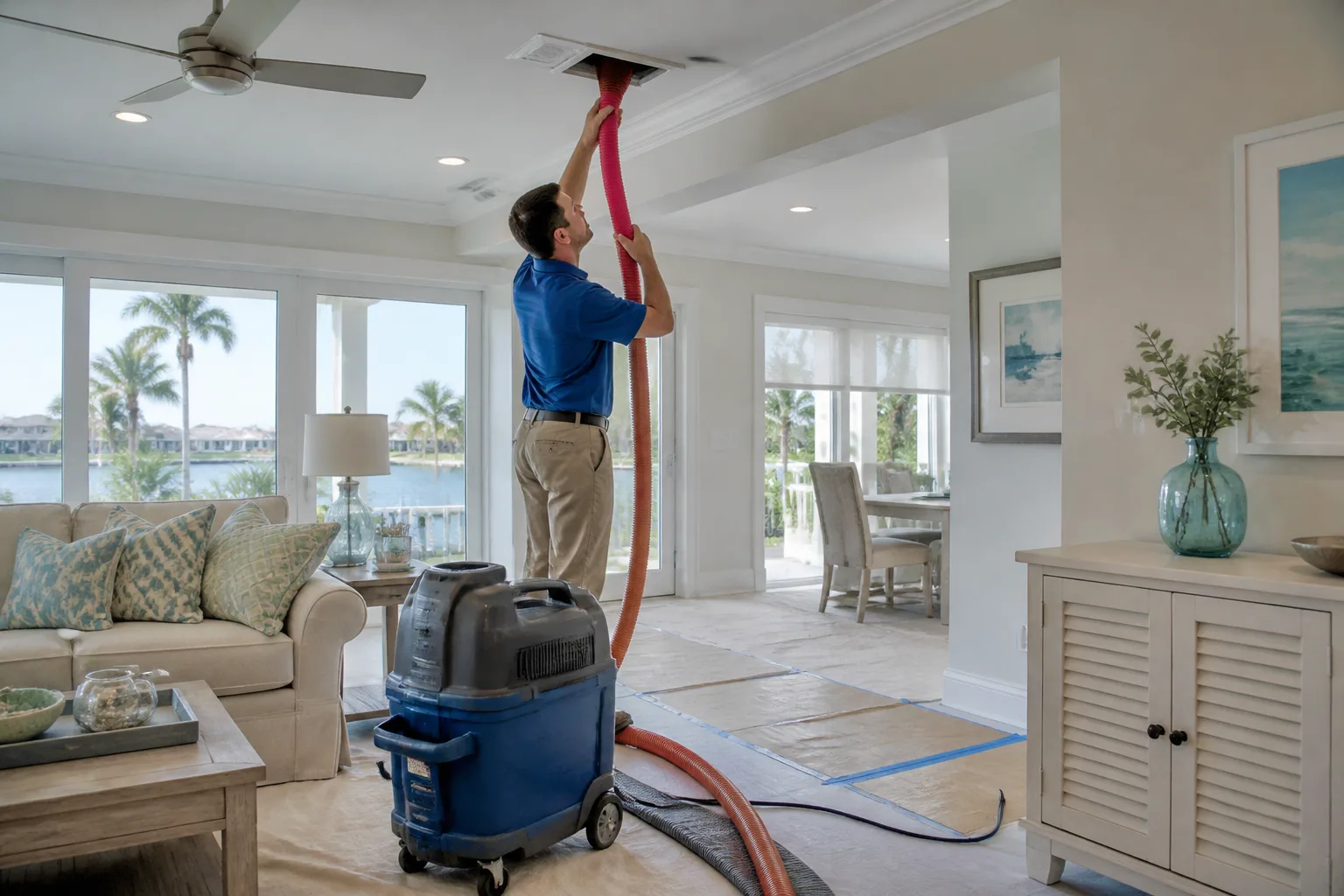
A Nikro negative-air machine is a portable HEPA-filtered vacuum that pulls a continuous, measured volume of air out of your duct system while the system is sealed. Restoration and remediation contractors choose portables over truck-mounts for contained residential work because the machine can be positioned at the point of collection, run through multiple filtration stages, and kept under negative pressure for the entire job. Truck-mount units are powerful but tethered to a hose length and often run at higher volume with less filtration.
The practical difference shows up in three places:
- CFM rating. CFM means cubic feet per minute, the volume of air the unit moves. A portable Nikro unit is rated so the operator knows exactly what negative pressure the setup can hold across a given duct layout.
- Filtration stages. Nikro machines run air through pre-filters and HEPA elements in sequence, so particulate is captured rather than exhausted back into the room.
- Containment. Because the unit sits inside the home and connects to the duct system directly, the operator controls where the air goes. That’s why contamination-sensitive work leans on portables.
If you want the deeper background on how a full system clean is scoped, our Duct Cleaning Clearwater page covers the process end to end.
How do agitation tools work differently on flex duct, sheet metal, and duct board?
Agitation is the half of duct cleaning that a vacuum alone can’t do. Loose dust lifts easily; the stuff bonded to duct walls needs to be mechanically broken free before the vacuum can carry it away. Nikro and Rotobrush accessory tools are built for that, but the right tool depends entirely on what your Clearwater home’s ducts are made of.
Flex duct is the corrugated plastic-and-wire run common in newer Florida construction and in retrofit work. It’s delicate. Rotary brushes can snag or tear the liner if the operator uses the wrong head or too much speed, so air whips and soft-bristle tools are the usual choice. A careful technician will also watch for sagging runs and disconnected joints, which flex duct develops more than any other type.
Sheet metal is the most forgiving material. Rotary brushes and skipper balls work well here, and the smooth interior means agitation actually reaches the full circumference of the run. Ducts that have been in service a long time often have a fine film that needs real mechanical contact, not just airflow.
Duct board is a fiberglass-lined rigid product with a coated face. Aggressive brushing can abrade that coating, which is why the tool selection matters more here than anywhere. Air whips and controlled agitation are standard.
An operator who shows up with one brush and no plan hasn’t asked what your ducts are made of. That’s a red flag regardless of brand.
What should you actually see and hear during a Nikro-equipped job in Clearwater?
You can judge a duct cleaning by observation, and you should. A properly set up job has visible, audible markers. During the work, listen for the steady hum of the vacuum running continuously, not cycling on and off. Look for every supply and return register sealed with tape or foam covers before the machine starts, because an unsealed register means the vacuum is pulling room air instead of duct air. Ask where the negative pressure is being established and watch that the machine stays connected for the whole run, not just the first few vents.
What you shouldn’t see is a technician blowing compressed air down a register with nothing attached to capture it. That method redistributes dust into the living space and is the exact opposite of what HEPA-level capture means.
At the end of the job, the collection bag or canister tells the story. A professional will show you what came out of your system before it goes in the trash. That inspection is your proof the work happened. We also photograph before-and-after conditions of the ducts themselves, so you’re looking at your own system, not a stock image.
Our technicians have up to 13 years of experience, and the setup procedure is the part they’re strictest about.
Why does the equipment brand matter less than the operator’s setup?
A $6,000 vacuum in careless hands does less than a mid-range unit set up correctly. The brand tells you what’s possible; the procedure tells you what’s happening in your house. This is where most homeowners get distracted, and where a fast-talking quote can hide a thin job.
Here’s what to verify regardless of what name is printed on the machine:
- Registers sealed before starting. All of them, supply and return, at every vent in the home.
- Continuous negative pressure. The vacuum runs for the entire cleaning, not in bursts between rooms.
- Agitation matched to duct material. Ask what tool they’ll use on your flex runs versus your metal trunk line.
- Filtration confirmed. Ask whether the exhaust air passes through HEPA elements and how many stages.
- Collection evidence shown. You should see what was removed.
- One flat price per system, agreed before work starts. No per-vent math, no surprise line items once the equipment is inside.
If a Clearwater contractor can’t answer these six, the equipment list on their website is decoration. The same discipline applies to the hardware behind your ducts; we work with Honeywell and Aprilaire air-quality components, which means filtration problems we find during a cleaning can be addressed rather than just noted.
What questions should you ask a Clearwater contractor about their vacuum before booking?
Ask about CFM, filtration, and setup, in that order. A contractor who does this work regularly will answer without hesitation. One who doesn’t will pivot to price.
- “What’s the CFM rating on your unit?” You don’t need to memorize the number. You need to hear whether they know it.
- “Does the machine run HEPA filtration, and how many stages?” HEPA-level capture is the difference between removing particulate and moving it around.
- “Will you seal every register before starting?” The answer should be yes, without qualifiers.
- “Do you use a portable or a truck-mount, and why?” Both can work. What matters is that the choice is deliberate.
- “Will I see the collection bag and before-and-after photos?” Documentation of the actual job is non-negotiable.
- “Is the price per system or per vent?” One flat price per system, agreed up front, written down.
This is the same standard we hold ourselves to. Our crews run Rotobrush and Nikro platforms, and for jobs where particulate control is the priority, Abatement Technologies equipment gives us negative-air and containment capability usually reserved for restoration work. That matters less as a sales point than as a setup answer: we can tell you exactly what’s running in your Clearwater home and why. If damaged or disconnected ductwork turns up mid-job, our air duct cleaning scope includes repair so the system is left whole, not just cleaner.
When should you call a pro instead of investigating further?
Call when you can see or smell a problem you can’t reach. Visible dust blowing from a register right after a filter change, a musty odor that comes back after cleaning the filter, or a run of rooms that never cool evenly all point to something inside the duct system. Those are inspection territory, not a shop-vac job, and no homeowner should be reaching into ductwork with a tool attached to a drill.
The other clear case is safety. Lint buildup in a dryer vent is a fire risk, and dryer vent cleaning is safety maintenance rather than optional upkeep. That work belongs to someone who knows how to clear the full run and verify airflow from the dryer through the exterior termination.
Related services in Clearwater: dryer vent cleaning for the lint side of your ventilation system, and duct repair when a run has come apart. More on our service area lives on the Clearwater page.
The Bottom Line
Nikro equipment is worth understanding because it tells you what a real duct cleaning requires: sustained negative pressure, staged HEPA filtration, agitation matched to your duct material, and a setup procedure the operator can explain. The brand is a proxy for capability. The procedure is what actually cleans your ducts. Ask about CFM, ask about sealing, ask to see the collection bag, and insist on one flat price per system agreed before the work starts.
If you’re in Clearwater and need help, Duct Cleaning Clearwater offers free estimates – call (844) 238-0931. Our technicians have up to 13 years of experience, we’re licensed and insured, and we’ll show you before-and-after photos of your own ducts. We answer 24/7. Fast dispatch from 7am to 7pm, Sunday through Friday.
Frequently Asked Questions
Neither is universally better; they solve different problems. Nikro portables offer contained, HEPA-filtered negative pressure positioned exactly where the work is, which suits residential jobs and contamination-sensitive homes. Truck-mounts move more air volume but are limited by hose reach and filtration setup. In Clearwater homes, what matters most is a deliberate choice with a proper setup, not the label on the machine.
There’s no single number that guarantees a good job, which is why we tell homeowners to ask rather than memorize. What you want is an operator who knows their unit’s rating, can explain how it holds negative pressure across your specific duct layout, and seals every register so that pressure isn’t wasted pulling room air. Call (844) 238-0931 for an exact quote – estimates are free.
It can help meaningfully when the system has real accumulation, and it does little when it doesn’t. Households with allergy sufferers, pets, or older duct systems tend to see the clearest difference. The honest first step is an inspection that confirms what’s in the system. If a contractor promises dramatic health results before looking at your ducts, that’s a sales script. Call (844) 238-0931 to schedule a free estimate.
You watch the setup and you inspect the result. Every register should be sealed before the vacuum starts, the machine should run continuously, and you should be shown the collection bag or canister along with before-and-after photos of your own ductwork. That documentation is the difference between a real clean and a quick visit. Call (844) 238-0931 for an exact quote – estimates are free.
Written by the team at Duct Cleaning Clearwater.
Need Air Duct Cleaning Help?
Call Duct Cleaning Clearwater - licensed & insured, here with fast help in Clearwater.
(844) 238-0931